AVEVA PI System Validation
IQ/OQ validation of the AVEVA PI System for GxP use, from validation plan to report, by the team that builds and supports PI Systems every day.
PI System validation for GxP environments
When PI System data supports GMP decisions, for example in batch record review, product release or quality investigations, the PI System becomes a GxP computerized system and has to be validated for its intended use. Amitec validates AVEVA PI Systems in pharmaceutical and chemical production: we prepare the validation documentation, qualify the system with IQ and OQ, and keep it in a validated state through changes and upgrades.
The same team installs, extends and supports PI Systems every day, as an AVEVA PI System integrator since 1998. That is why our validation documents describe how your system really works, and why qualification fits into your support level agreement afterwards.
Validation documentation
Validation plan, risk assessment, IQ and OQ protocols, traceability matrix and validation report, written to your SOPs and templates, in English or German.
The whole PI System
Servers and infrastructure, PI Data Archive, interfaces, PI Asset Framework and PI Vision, including the displays your teams use for GMP decisions.
Aligned with GxP standards
A risk-based approach following GAMP 5, with the applicable requirements of FDA 21 CFR Part 11 and EU GMP Annex 11 mapped to technical and procedural controls.
What a PI System validation includes
Each validation follows your validation master plan and quality system. Depending on scope and risk, a PI System validation with Amitec includes:
- Validation plan and test strategy, aligned with your SOPs
- Inventory of servers, interfaces and PI components, and a GxP risk assessment for each function
- Support with the user requirements specification (URS) and the functional and design specifications
- Installation qualification (IQ): servers, PI software, interfaces, security and backup as specified
- Operational qualification (OQ): the functions in your requirements, such as data collection, archiving, user access, backup and restore
- Test execution with documented evidence and deviation handling
- Traceability matrix from every requirement to its test
- Validation report and handover into change control
- Performance qualification (PQ), training and periodic reviews where your requirements call for them
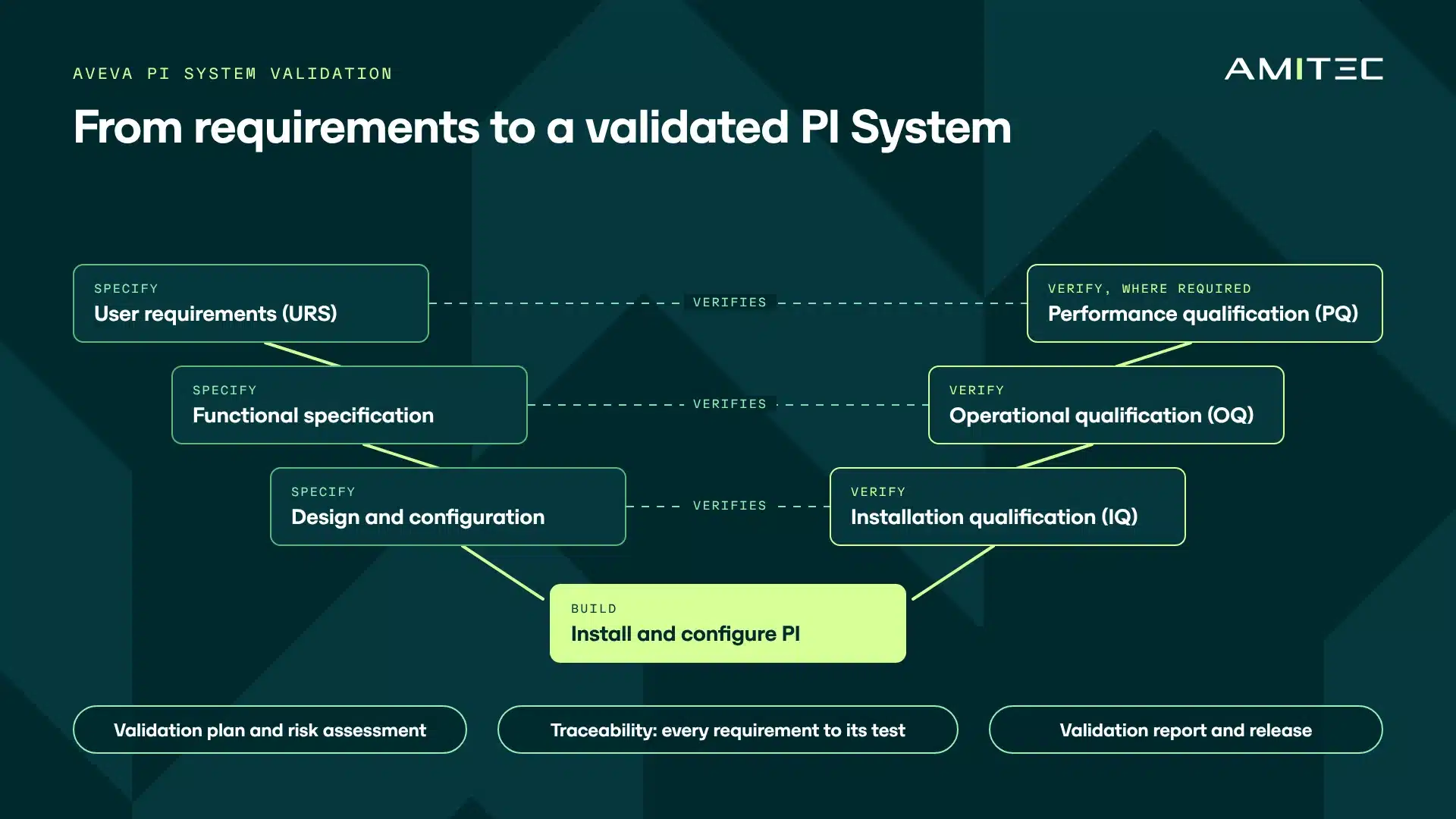
How a PI System validation runs
A PI System validation runs in six steps, from the first assessment to the released system and beyond. One Amitec project manager stays your contact throughout, and your quality unit approves each document before testing starts.
01
Assess
Inventory of servers, interfaces and PI components.
Review of your URS and the intended use.
Result: Scope and risk assessment
02
Plan
Validation plan and test strategy.
Agreement on templates, language and approvals.
Result: Approved validation plan
03
Specify
Functional and design specifications.
IQ and OQ protocols, reviewed by your QA.
Result: Approved test protocols
04
Qualify
IQ and OQ execution with documented evidence.
Deviations recorded and resolved.
Result: Executed and signed tests
05
Report
Traceability matrix and validation report.
Handover to your change control.
Result: Released system
06
Maintain
Changes and upgrades under change control.
Periodic review support under an SLA.
Result: System stays validated
Documents: written to your SOPs and templates, in English or German. Approvals: your QA signs off plan, protocols and report. Scope: as defined in your URS, from servers and PI Data Archive to interfaces, PI Asset Framework and PI Vision.
Keeping your PI System validated
A PI System keeps changing: new tags and interfaces, new displays, software upgrades and server replacements. We plan these changes with you under change control, assess their impact on the validated state, run the regression tests they need and document the result. Under our support level agreement, the same team supports periodic reviews and documented upgrades, so the validated state is maintained between projects.
Tools for validated PI Vision environments
- reVision backs up every PI Vision display when it is saved and keeps a change history with author and time stamp, with one-click rollback to earlier versions.
- The PI Vision Suite adds Watermark, which marks displays as GxP or non-GxP, and Data Entry, which records manual values in PI tags and AF attributes directly from PI Vision.
What our customers say
A pharmaceutical customer on PI System validation with Amitec. The name is withheld at their request.
Frequently asked questions about PI System validation
When does a PI System need to be validated?
When its data supports GMP decisions, for example batch record review, product release or quality investigations, the PI System is a GxP computerized system and has to be validated for that intended use. Your quality unit defines the intended use, and we help turn it into requirements and a validation scope.
Can you validate a PI System that Amitec did not install?
Yes. We start with an inventory of the installed components and a gap assessment against your requirements, and plan any changes the system needs before qualification.
Do you work with our SOPs and templates?
Yes. Validation documents follow your SOPs and templates, and we write them in English or German.
Is PQ included?
IQ and OQ are the core of a PI System qualification. We add performance qualification (PQ) when your requirements call for it.
Can PI Asset Framework and PI Vision displays be included?
Yes. The scope follows your URS. PI Asset Framework and the PI Vision displays used for GMP decisions can be validated together with the system or in a later phase.
How do 21 CFR Part 11 and EU GMP Annex 11 apply to the PI System?
That depends on the intended use. In the risk assessment we map each applicable requirement, such as audit trail, access control or electronic records, to a technical control in the PI System, an additional AVEVA component or a procedural control in your SOPs.